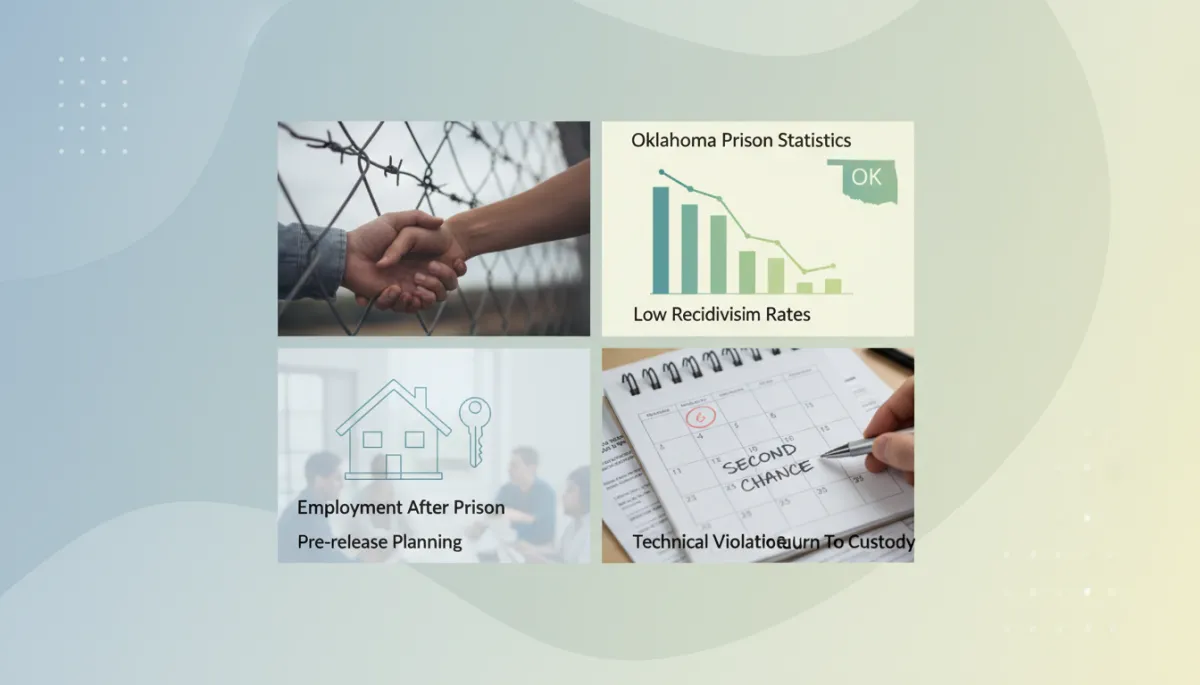
Understanding Oklahoma's Low Recidivism Rates
Recidivism Rates, Oklahoma Prison Statistics, Faith-Based Reentry, Employment After Prison
Getting the Numbers Right: What Oklahoma’s Low Recidivism Rate Really Means
Most people assume that almost everyone released from prison ends up back behind bars. In reality, Oklahoma’s three-year Recidivism Rates are roughly 22.6 percent in some reports—and closer to 18 percent in the most recent state data—about one in five, among the lowest in the country. For a man just walking out of a gate, and for the churches, employers, landlords, and neighbors who will meet him, understanding that number correctly can change everything.
Why Recidivism Measures Differ So Widely
When you hear someone say, “Two-thirds of people go back to prison,” they may not be talking about the same thing Oklahoma’s official Oklahoma Prison Statistics are measuring. “Recidivism” is a single word that can hide very different realities, depending on how it is counted. Three questions make all the difference:
What is being measured? Some studies track rearrest (any arrest after release). Others track reconviction (a new guilty finding in court). Oklahoma’s core measure focuses on Return To Custody—someone actually going back to prison or jail for a period of time.
How long is the follow-up window? A one-year rate will always be lower than a three-year rate, and a three-year rate will be lower than a five-year rate. Most state comparisons, including Oklahoma’s, use a three-year window to keep things consistent.
Who is included? Some counts include only people released from prison. Others mix in people leaving county jails or probation. Local jail booking data, like Oklahoma County’s high repeat-booking percentage, can look much worse than statewide prison return data because it is measuring something different.
Nationally, big “two-thirds return” headlines often come from federal studies that track rearrest for up to nine years. That paints a very different picture than Oklahoma’s three-year Return To Custody rate of roughly 18–22.6 percent. Both are real numbers, but they are not talking about the same thing.

Clear definitions of recidivism help churches and partners respond with wisdom, not fear.
Three Reasons Almost Everyone Guesses Wrong
Ask a room of people, “What percentage of those released from prison in Oklahoma are back within three years?” Most will guess 50, 60, even 80 percent. Why are we so far off from the truth?
We remember stories, not statistics. News headlines feature the man who got out and committed a terrible crime—not the four who quietly went to work, rejoined their families, and never showed up in the paper again. Our minds then assume the rare story is the normal story.
We mix up different measures. People often hear a national “rearrest” rate and assume it means “back in prison.” They hear a five- or nine-year figure and assume it is three years. Without realizing it, they stack the worst-sounding numbers together and apply them to their own state.
We underestimate change. Oklahoma’s Oklahoma Prison Statistics show that recidivism has been falling—from around 24 percent in 2016 to under 20 percent in recent years. Many people are still quoting older data, or assuming nothing has improved, even as reentry efforts and reforms have quietly made a real difference.
📌 Key Takeaway: When we guess too high, we can accidentally treat every man coming home as if he is almost certain to fail—exactly the opposite of the hope we’re called to offer.
What Oklahoma’s Low Recidivism Number Does Not Mean
A three-year recidivism rate around one in five is encouraging, but it is not a victory lap. Misreading the number in the other direction can be just as harmful. Here is what it does not mean:
It does not mean four out of five people face no struggles after prison. Many wrestle with addiction, trauma, mental health, or unstable housing without ever being sent back to custody.
It does not mean public safety is guaranteed. Even a small percentage of serious new offenses matter deeply to victims, families, and communities. Accountability and wise supervision still matter.
It does not mean we can relax our support. Often, low recidivism is the fruit of strong programming, mentoring, and community involvement. Take those away, and the numbers can rise again.
For a faith-based reentry ministry like Genesis One Network, the statistic is a signpost, not a finish line. It tells us that transformation is possible at scale—but every man still needs a path, a people, and a purpose after release.
Technical Violations vs. New Offenses: Why Many Returns Aren’t New Crimes
Another hidden layer in Recidivism Rates is the difference between technical violations and new offenses. Research across the country shows that a large share of returns to prison are not because someone committed a new crime, but because they broke a rule of supervision.
Technical Violations might include missing an appointment with a parole officer, failing a drug test, missing curfew, or leaving the county without permission. These are serious, but they are not new criminal charges.
New Offenses involve being arrested, charged, and often convicted for a new crime—such as burglary, assault, or drug distribution.
When Oklahoma reports a return to prison, both situations can be counted as a Return To Custody. From a public safety standpoint, though, they are very different. A man who relapses once and reports it honestly, then is revoked for a positive test, is not the same as a man who commits a violent robbery. Yet both may show up under the same “recidivist” label.

Many returns to custody stem from supervision rules, not new criminal behavior.
For ministries and families, this matters. It reminds us that relapse, missed appointments, and other Technical Violations are often signals that someone needs more support, not less. Grace does not erase accountability—but it does help us respond with restoration in mind.
What the Corrected Number Should Change for All of Us
If Oklahoma’s true three-year prison recidivism rate is closer to one in five than “almost everyone,” what should that change in real life? Quite a lot.
For employers: The man sitting across from you is statistically more likely to stay out than to return. Employment After Prison is one of the strongest protections against recidivism. Offering a job is not just charity; it is a proven public safety strategy.
For landlords: Stable housing is another key factor in lower Recidivism Rates. When you open a door, you help prevent the instability that can lead to technical violations or desperate choices. Screening is wise; blanket rejection is not required by the facts.
For congregations: A church that welcomes men and women coming home is not taking a wild risk; it is joining the Lord in what He is already doing in Oklahoma. The numbers say transformation is happening. Our call is to disciple, mentor, and walk with people so that statistic becomes a story of new life in Christ.
For the man who is out: You are not doomed to repeat your past. The data says that most people in your shoes do not go back. With accountability, community, and faith, your odds of success are even stronger than the averages suggest.

Fair chances in housing and employment are powerful tools for lowering recidivism.
Targeting the Sequence, Not Just the Statistic
At Genesis One Network, we believe that to keep lowering Oklahoma Prison Statistics on recidivism, we must focus on the sequence of a man’s journey, not just the final number. That means walking with him before, during, and after release through several key stages:
Accountability: Real change requires honest ownership of past choices and current temptations. Faith-based mentoring creates safe spaces to confess, repent, and grow, while still honoring supervision requirements and victim concerns.
Pre-release Planning: Long before the gate opens, we help men think through where they will live, how they will get to work, what triggers they must avoid, and how they will stay connected to a church. Strong Pre-release Planning turns vague hopes into concrete steps.
Mentoring and discipleship: Consistent relationships—with a mentor, a pastor, a small group—provide encouragement when shame or old friends call. A man who knows he will be asked, “How are you really doing?” is less likely to drift into isolation and relapse.
Job support: From résumé help to introductions to second-chance employers, Employment After Prison is not left to chance. Work restores dignity, provides structure, and makes compliance with supervision rules more realistic.
Aftercare: The first 90 days after release are often the most fragile. Aftercare teams follow up, help solve problems before they become Technical Violations, and stand beside men when life hits hard.
💡 Pro Tip for Partners: Don’t just ask, “What’s the recidivism rate?” Ask, “What does your support look like at every step—inside, at the gate, and in the community?”
From Numbers to Names: How You Can Help
Oklahoma’s low recidivism rate tells a hopeful story: change is possible, and it is already happening. But statistics do not mentor a man, hire him, or welcome his family back into community. People do. Churches do. Employers and landlords do. Ministries like Genesis One Network do—by the grace of God and with the help of partners like you.

When communities walk with returning citizens, statistics become stories of redemption.
As we correct our understanding of Recidivism Rates in Oklahoma, may it correct our posture too—from fear to faith, from distance to welcome, from stereotypes to specific support. One in five may return to custody within three years, but in Christ, every one has the chance to become a new creation.
If you are an employer, landlord, pastor, or neighbor, we invite you to partner with Genesis One Network. Help us focus not just on lowering a statistic, but on walking with each man through the full sequence of change—so that, by God’s grace, he never has to go back.