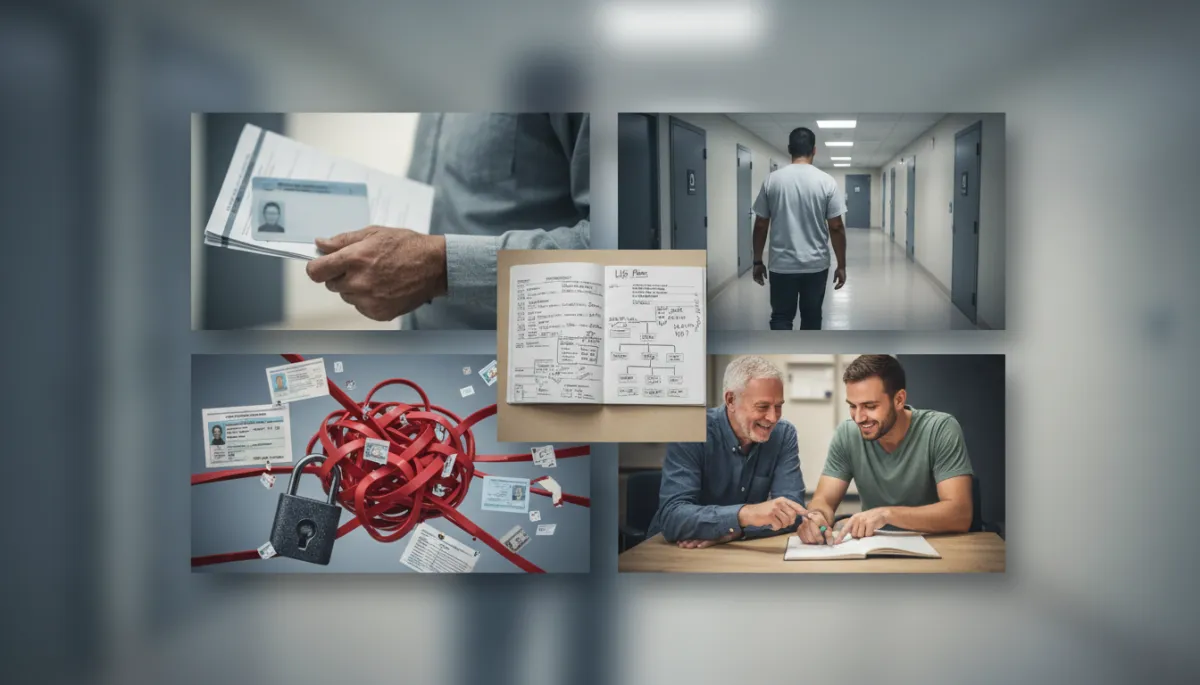
Overcoming Identity Barriers After Prison
Reentry Barriers, Identity Verification, Criminal Justice Reform, Life After Prison
The Barrier Nobody Names in Reentry: When You Can’t Prove You Are You
For many men and women leaving prison, the hardest wall they hit isn’t made of concrete and razor wire. It’s made of paper. Before they can work, rent a room, open a bank account, or even pick up a prescription, they have to pass a test most of us never think about: proving they are who they say they are. This invisible barrier in reentry quietly derails fresh starts every day in Oklahoma and across the country.
The Barrier Nobody Names in Reentry
When people talk about Reentry Barriers, we usually hear about housing, employment, and stigma. Those are real and painful. But beneath them sits a quieter obstacle that often goes unnamed: Identity Verification. A man can walk out of prison after ten or twenty years and discover that, in the eyes of the systems he must now navigate, he is almost a stranger. His driver’s license is long expired. His Social Security card is missing. His birth certificate is in a county office two states away. Without those documents, “Life After Prison” stalls before it even begins.
At Genesis One Network, we meet men who are eager to work, to reunite with family, and to live differently through faith in Jesus Christ. But they step into freedom and quickly find that freedom still comes with locked doors. Not because they are unwilling, but because they cannot prove they are who they say they are to the very systems that demand it. This is the barrier nobody names, yet it shapes every other part of reentry.
The Closed Loop: Every Door Needs a Key You Don’t Have
The reentry identity problem is a closed loop. It looks simple on paper, but it traps real people in quiet desperation. Here’s how it works.
A job requires an ID. Employers need a government-issued photo ID and a Social Security number to complete hiring paperwork. No ID, no job. The man who is ready to work is turned away before he can prove his skills or his new mindset.
An ID requires a birth certificate. To get a state ID or driver’s license, you usually must show a certified birth certificate. If you were born in another state, that means contacting a vital records office you cannot easily reach, paying a fee you may not have, and waiting for mail you may not be able to receive.
A Social Security card requires photo identification. To replace a lost or stolen Social Security card, the Social Security Administration asks for valid photo ID. So the card you need for a job is held behind the ID you don’t yet have.
In other words, every door requires a document held behind another door. You need an ID to get a job, a job to pay for documents, documents to get an ID. This circular maze is one of the most stubborn Documentation Challenges in modern Criminal Justice Reform, and yet it rarely makes headlines because it does not look like a crisis. It looks like someone “dragging their feet,” when in truth, they are stuck in a system that was never designed with reentry in mind.

Missing IDs turn simple tasks into exhausting obstacle courses after release.
The Practical Layers: No Bank Account, No Address, and Office Hours You Can’t Reach
The loop tightens when you add the practical realities of reentry. Many men leave prison with no functioning bank account. Without a bank account, they may be paid in cash or not at all. They cannot easily cash a check without more identification. They cannot set up direct deposit, pay bills online, or build even a small emergency cushion. This financial instability magnifies every other barrier.
Then there is the question of a mailing address. To receive a birth certificate, an ID, or a Social Security card, you need a stable address. But to secure stable housing, landlords often ask for pay stubs, references, and identification. Some men bounce between couches, motels, or shelters, places where mail is unreliable or unsafe. Important documents get lost, stolen, or returned to sender. The circle keeps spinning.
Finally, consider the reality of weekday-only office hours. Vital records offices, DMV locations, Social Security offices, and many community agencies are open only during regular business hours. For someone just trying to find daily transportation, check in with supervision, attend mandatory classes, and maybe pick up day labor, making it across town between 9 a.m. and 4 p.m. can feel impossible. One missed bus or long line can mean another week or month of waiting.
💡 Faith-Driven Insight: Scripture tells us, “The Lord is near to the brokenhearted.” At Genesis One Network, we believe that includes the man standing in line at the DMV, praying this time he has the right papers and won’t be turned away again.
Idle Time, Invisible Shame: What the Paperwork Problem Really Produces
The cruelest part of these Documentation Challenges is not only the delay. It is what the delay does to the human heart. While a man waits for his birth certificate or a replacement Social Security card, he is often stuck in a kind of limbo. He cannot work legally, cannot sign a lease, and may not even be able to volunteer in certain places without background checks that require identification. The system quietly manufactures idle time.
Idle time is dangerous in reentry. It leaves space for old voices to creep back in: “You’ll never change.” “Nobody wants you.” “You’re just a number.” When every counter says, “Come back when you have the right papers,” the message underneath is, “You don’t belong here.” That message breeds shame, not hope. And because this struggle happens in waiting rooms, bus stops, and long, quiet afternoons, it rarely shows up as a visible crisis. To the outside world, it can look like lack of motivation. Inside, it feels like rejection on repeat.

Delays in documentation quietly fuel discouragement and temptation to give up.
Why This Must Be Handled Before Release: Pre-Release Work and a Customized Life Plan
If the identity barrier is built from paperwork, it can also be dismantled by paperwork—but only if we start early. True Criminal Justice Reform must recognize that Identity Verification is not a side issue; it is foundational. That is why Genesis One Network advocates for this work to begin before release, not after. By the time a man steps out of the gate, he should already have a plan and, whenever possible, the core documents he needs in hand.
A strong pre-release process includes helping each individual build a Customized Life Plan. This is more than a checklist. It is a faith-centered roadmap that asks practical and spiritual questions: Where will you sleep the first week? Who will you call when you feel overwhelmed? Do you have your birth certificate, Social Security card, and state ID? What steps must happen, and in what order, to move from release day to stable employment and housing?
When prisons and community partners work together, much of the documentation work can happen while a person is still inside. Requests for birth certificates can be mailed. Social Security records can be checked. Applications for state IDs can be prepared so that the final step after release is a simple appointment, not a scavenger hunt. Every form completed ahead of time shrinks the gap between “I’m free” and “I can function.”
📌 Key Takeaway: When identity documents are secured before release, the first weeks of reentry become a season of building, not just waiting. That is where hope has room to grow.
Where a Post-Release Mentor Makes the Difference
Even with a Customized Life Plan, the world outside can feel overwhelming. That is why Post-release Support is not optional—it is essential. A mentor cannot magically make offices stay open longer or speed up government processing times. But a mentor can do something just as powerful: walk with a person through the maze so they do not have to face it alone.
A post-release mentor from Genesis One Network might help a man gather the right forms, schedule appointments, and plan bus routes. They might sit beside him in a waiting room, pray with him before a difficult conversation, or remind him that a setback at the DMV is not a sign that God has given up on his story. Mentors help turn shame into shared struggle, and idle time into purposeful steps—studying Scripture, attending support groups, practicing job skills, and following through on the Life Plan they built together.

Faith-based mentoring turns confusing paperwork into shared, hopeful next steps.
In a world that often reduces people to case numbers, a mentor offers a different message: “You are seen. You are known. You are more than your past.” That message, rooted in the love of Christ, gives courage to keep pushing through lines, forms, and closed loops until real progress is made. It is one of the most practical and powerful tools we have to reduce recidivism and build a different future.
Partner With Us to Break the Hidden Barrier
The paperwork barrier in reentry may be quiet, but it is not inevitable. With thoughtful pre-release planning, a strong Customized Life Plan, and committed Post-release Support, we can make sure no man or woman walks out of prison unable to prove they are who they say they are. We can replace idle time with meaningful steps, and shame with the dignity that comes from being prepared and supported.
Genesis One Network exists to walk this journey with returning citizens in Oklahoma—from prison chapel services to community mentoring circles, from first paperwork appointments to first paychecks. Our faith in Jesus Christ compels us to believe that every person is more than their record, and that with the right help, Life After Prison can be marked by transformation, restored families, and steady hope.
If you are an individual, church, or community partner who shares this vision, we invite you to join us. Volunteer as a mentor, support our programs, or help advocate for policies that prioritize identity documentation as a core part of reentry. Together, we can break this hidden barrier and open real doors—for work, for family, and for the new life God is ready to write.
Partner with us to support offenders’ transformation and successful reentry into society. When we make sure a man can prove who he is, we do more than fix paperwork. We affirm his God-given identity and give his new beginning a fair chance to flourish.