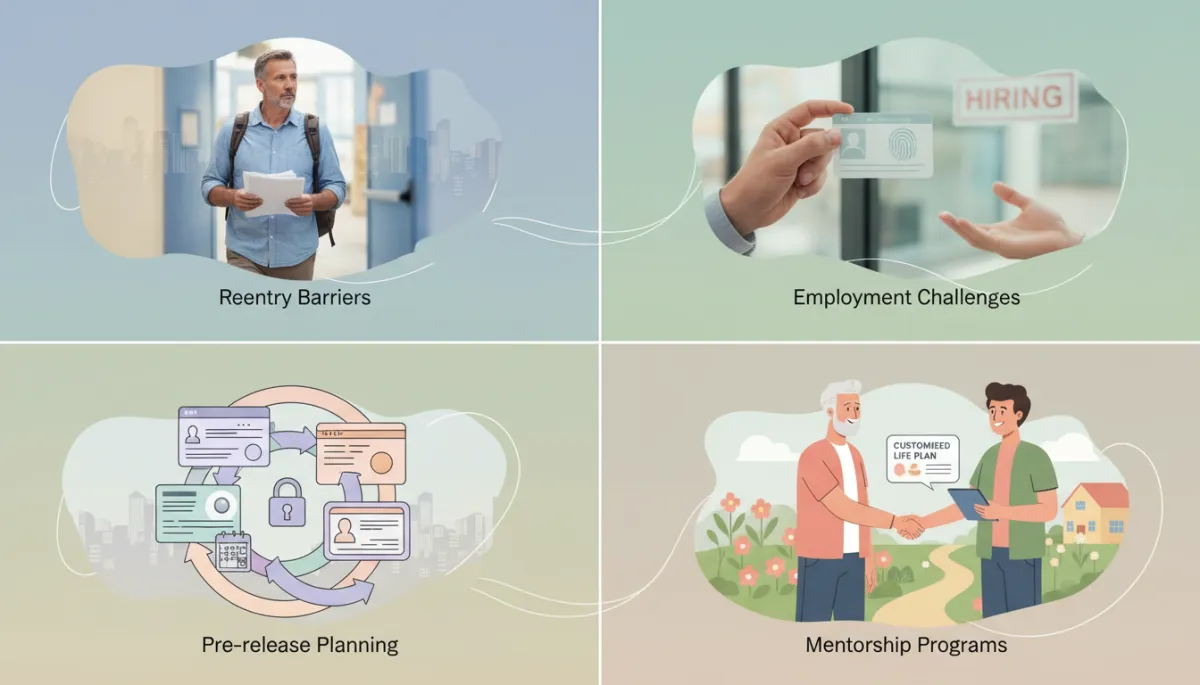
Overcoming Identity Barriers in Reentry
Reentry Barriers, Identity Verification, Employment Challenges, Pre-release Planning, Mentorship Programs, Documentation Issues
The Barrier Nobody Names in Reentry: When You Can’t Prove You Are You
Many people imagine reentry barriers as big, obvious walls: finding work, staying sober, rebuilding family trust. But one of the most devastating obstacles is far quieter and more hidden—walking out of prison unable to prove you are who you say you are. For nonprofits, churches, and community partners, understanding this invisible barrier is the first step to truly supporting our neighbors coming home.
The Man at the Gate With No Proof of Himself
Picture this: a man walks out of an Oklahoma prison with a few dollars, a sack of belongings, and a heart full of hope. He served his time. He’s ready to work, reconnect with his children, and start again with God’s help. But by the end of the first week, he has hit a barrier he never saw coming—he cannot prove his own identity.
His driver’s license expired years ago. He doesn’t have a copy of his birth certificate. His Social Security card was lost somewhere between arrests, transfers, and property rooms. On paper, he simply doesn’t exist. And in our modern world, if you can’t prove who you are, almost every other step of reentry freezes in place.
The Closed Loop of Documents: Every Door Locked Behind Another Door
For many in reentry, Identity Verification becomes a cruel maze. Nonprofits and ministries often see the frustration, but not always the full loop. It usually looks like this:
A job application or background check requires a government-issued photo ID.
To get that ID, the state requires a certified birth certificate and often a Social Security card.
To replace a Social Security card, you usually must show a valid photo ID and proof of citizenship or age—often a birth certificate.
Every door requires a document that is locked behind another door. A man can spend weeks trapped in that loop, simply trying to assemble the basic papers that most of us keep in a drawer at home. Meanwhile, the clock on his parole conditions, housing deadlines, and family expectations is still ticking.

Missing documents can stall reentry for weeks before a job search even begins.
Hidden Layers: No Bank Account, No Address, and Weekday-Only Doors
Documentation Issues rarely travel alone. They show up with a whole set of practical Reentry Barriers that nonprofits and churches in Oklahoma see every day:
No bank account. Opening a checking account requires photo ID and often proof of address. Without an account, he may be paid in cash or not hired at all. Saving, budgeting, and paying bills become much harder.
No stable mailing address. The birth certificate office wants to mail documents. Social Security wants to send a confirmation letter. But he’s staying on a cousin’s couch, in a shelter, or moving from place to place. Mail gets lost, delayed, or returned.
Weekday-only office hours. Vital records offices, DMV locations, and Social Security offices are typically open during standard work hours—exactly when a new job, a day-labor shift, or a required class might also be scheduled. Transportation from rural areas or halfway houses adds another layer of difficulty.
None of this looks dramatic from the outside. There’s no headline, no flashing alarm. Just a man sitting in a borrowed chair, staring at a stack of forms and wondering how he’s supposed to do all of this “right” when the system seems designed for people who never left the free world.
📌 Key Takeaway: Until basic identity documents are secured, Employment Challenges, housing, and even medical care remain out of reach, no matter how motivated someone is to change.
Idle Time and Invisible Shame: The Emotional Cost of Paperwork Delays
The paperwork problem rarely shows up as a visible crisis. Instead, it quietly manufactures idle time and shame. Days turn into weeks of “waiting on documents.” He can’t work yet. He can’t sign a lease. He can’t open a bank account. To family and friends, it can look like laziness or lack of effort. Inside, it feels like failure and humiliation.
Idle time is dangerous for anyone, but especially for someone freshly out of prison. Old voices, old habits, and old temptations grow louder when a man feels stuck and useless. He may start to believe the lie that he’s “just a felon” who will never get ahead. This is exactly where the cycle of recidivism often begins—not with a big decision to reoffend, but with a slow erosion of hope while waiting on a piece of paper in the mail.

Paperwork delays quietly drain hope long before a visible crisis appears.
For faith-based communities and nonprofits, this is a spiritual and emotional battlefield. Shame whispers, “You can’t even get an ID. How will you ever be a father, an employee, a man of God?” That’s why ministries like Genesis One Network treat documentation as more than a technical detail—it is a frontline issue of dignity, identity, and hope.
Why Identity Must Be Handled Before Release: Pre-release Planning and a Customized Life Plan
The truth is simple: by the time someone reaches the front gate, it is already late to start chasing birth certificates and Social Security cards. Pre-release Planning is where this battle must be fought. When we address Reentry Barriers inside the walls, we give men and women a real chance to walk out ready to move forward, not just ready to stand in line at the DMV.
At Genesis One Network, we advocate for a Customized Life Plan that starts months before release. That plan doesn’t just list goals like “get a job” or “find housing.” It breaks those goals down into the concrete steps that make them possible, including:
Verifying where a birth certificate is held and beginning the request process while the person is still incarcerated.
Completing Social Security applications or replacement forms in advance, when possible, with staff or volunteers guiding each step.
Planning transportation and schedules for first-week appointments at vital records, DMV, and Social Security offices after release.
Identifying a safe mailing address—through a family member, church partner, or nonprofit office—where documents can reliably be sent.
When identity documents are built into a Customized Life Plan, they move from an afterthought to a foundation. The person steps through the prison gate with a roadmap, not just a release date. That’s the difference between starting reentry with momentum and starting it already behind.
💡 Pro Tip for Nonprofits and Churches: Ask every participant about their birth certificate, Social Security card, and ID status before release, and build those steps into their reentry plan.
Where a Post-release Mentor Makes the Difference
Even with solid Pre-release Planning, the real world is messy. Forms get rejected. Offices change policies. A bus is late, an appointment is missed, and suddenly a man feels like he’s right back at square one. This is where Mentorship Programs are not just helpful—they are life-changing.
A post-release mentor from Genesis One Network can:
Ride along to the DMV or Social Security office, helping navigate confusing instructions and long lines.
Provide a stable mailing address through a partner church or nonprofit office, so documents have a safe place to land.
Encourage the person spiritually when delays and setbacks stir up shame, reminding them of their identity in Christ, not just on paper.
Help turn waiting time into growth time—using those days for Bible study, job-readiness classes, and relationship building instead of despair.

A trusted mentor turns confusing paperwork into a shared, hopeful process.
Mentors help transform Identity Verification from a lonely struggle into a shared journey. Instead of a man silently drowning in forms, he walks with someone who can say, “I’m with you. We’ll get through this together.” That kind of support doesn’t just solve Documentation Issues—it rebuilds confidence, responsibility, and faith.
How Nonprofits and Faith Communities Can Respond
For nonprofits, churches, and community partners across Oklahoma, this hidden barrier is an invitation. If we want to reduce recidivism and support true transformation, we must treat identity documents as core ministry work, not side paperwork. That means:
Building simple checklists and workshops focused on IDs, birth certificates, and Social Security cards as part of every reentry class.
Training volunteers to walk with returning citizens through government processes with patience and grace.
Partnering with organizations like Genesis One Network to integrate Pre-release Planning, Customized Life Plans, and Mentorship Programs into local ministry efforts.
When we help someone secure their documents, we are doing more than solving a bureaucratic puzzle. We are affirming, “You belong here. You have a name, a story, and a future.” For a man or woman coming out of prison, that message can be the first step toward a life rebuilt on faith, responsibility, and hope.
Partner With Genesis One Network to Break This Hidden Barrier
Genesis One Network exists to walk with men and women before and after release, addressing Reentry Barriers from the inside out. Through faith-based mentoring, Customized Life Plans, and practical support with Documentation Issues, we help ensure that no one stands at the prison gate unable to prove who they are—on paper or in Christ.
If you are a church, nonprofit, volunteer, or supporter in Oklahoma, we invite you to join us. Partner with us to support offenders’ transformation and successful reentry into society. Together, we can make sure that when someone walks out of prison, they carry not only their belongings, but also their identity, their dignity, and a community committed to their new beginning.